Disaster Resilience Through Art in Appalachia
Appalachia is a region of resilience. The people of these hills and hollers remain steadfast through tight local bonds and values. In response to an increase in natural disasters in states like Kentucky, West Virginia, and North Carolina, many Appalachian artists and communities have begun implementing public art projects as a way to come together, beautify their communities, and practice resiliency through art. These works can also aid in the collective healing process by providing an outlet for storytelling.
This list of projects simultaneously helped communities process their post-disaster grief and amplify the rich stories and cultures of the communities they were created in.
Kelson Thorne
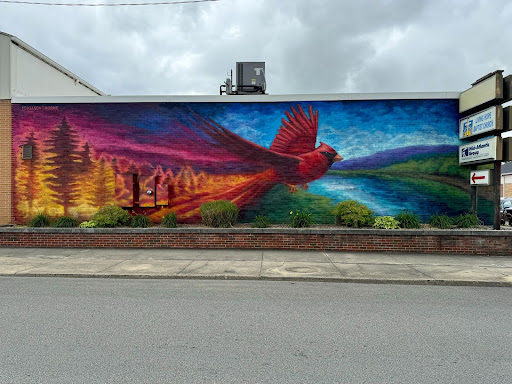
Mural on the wildfires in Grant and Hardy County – Kelson Thorne
Kelson Thorne has completed multiple murals in Petersburg, WV, but in particular has made a great impact with his work inspired by the wildfires that Grant and Hardy County faced in March of 2024. As Thorne explains, “The mural serves as a metaphor for regrowth and rejuvenation; despite their devastation, wildfires enrich the soil and create new habitats for plants and animals. Witnessing our community unite during such challenging times has deepened my pride in Petersburg.”
Lacy Hale
Working with the Cowan Community Action Group in Whitesburg, KY, Lacy Hale led a mural project for the group’s annual Growing Home event. This event is to commemorate both the flood of 2022, but also the growth of their communities and the strength.
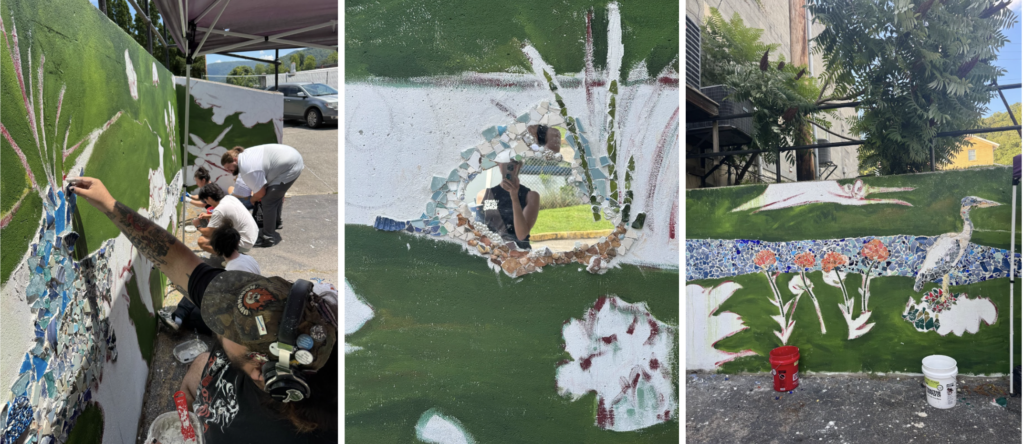
‘Pieces of Home: Stream of Stories.’ – Lacy Hale
Providing more details, Hale explains, “I led the steps mural project for the same event last year. Valerie Ison Horn, director of the Cowan Community Action Group, suggested a mosaic. I had never done a mosaic before, but I said I’d try. While discussing the project and learning about the different ways you can create a mosaic, I found that broken pieces of pottery, jewelry, etc. can be included. I have had a mug of my dad’s for years. He passed away in 2008 and I kept the mug. I accidentally broke it several years back and never could make myself part with it. I thought that it would be perfect to include in the mosaic and what if folks from the community would want to contribute pieces of their broken treasures to the project? We could collect the stories of the pieces and it would be an archive of community members’ sharing important parts of their lives. From there, we decided to name the project ‘Pieces of Home: Stream of Stories.’ The mural includes a stream – many of us have a complicated relationship with water since the flood in 2022 – and native plants and animals.”
The mosaic was completed, and the stories of the broken treasures are being continually added to their site regularly: https://streamofstories.my.canva.site/
Suzanne Barrett Justis
Collaborating with Create Appalachia, a Tennessee nonprofit based out of Kingsport, Suzanne Barrett Justis is doing what she does best in order to provide disaster relief: creating art.
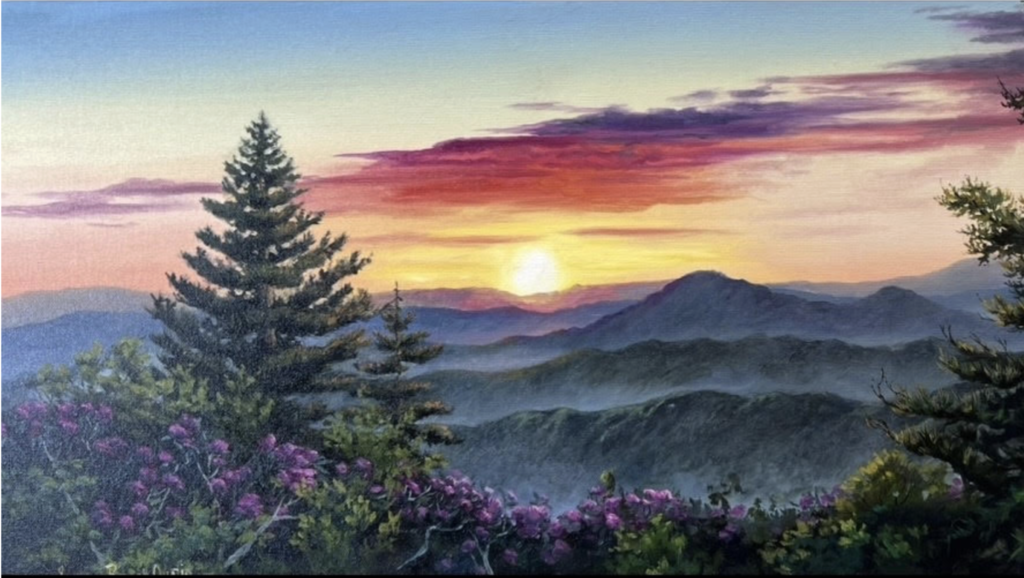
“Appalachian Dawn-Appalachian Strong” – Suzanne Barrett Justis
Being inspired by the rising sun bringing Appalachia a new day after Hurricane Helene had ravaged the region, Barrett Justis created “Appalachian Dawn-Appalachian Strong.” In her own words, “Art has a unique power to transform pain into expression, giving communities struck by natural disasters, such as Hurricane Helene, a way to reclaim their stories. Through painting, music, or sculpture, people can process loss, preserve memory, and rebuild a sense of shared hope. That was what I had hoped my painting “Appalachian Dawn-Appalachian Strong” would do. Give hope, turning devastation into resilience and beauty. As a visual artist, I felt helpless at the time, seeing what had happened to The River Arts District in Asheville, NC I was wondering what I could do to help. The best thing I could do was paint, and paint was what I did. The painting “Appalachian Dawn-Appalachian Strong” was made into prints, and the profits from the sale of the prints went to hurricane relief.”
Caitlin Adams and Andi Gelsthorpe
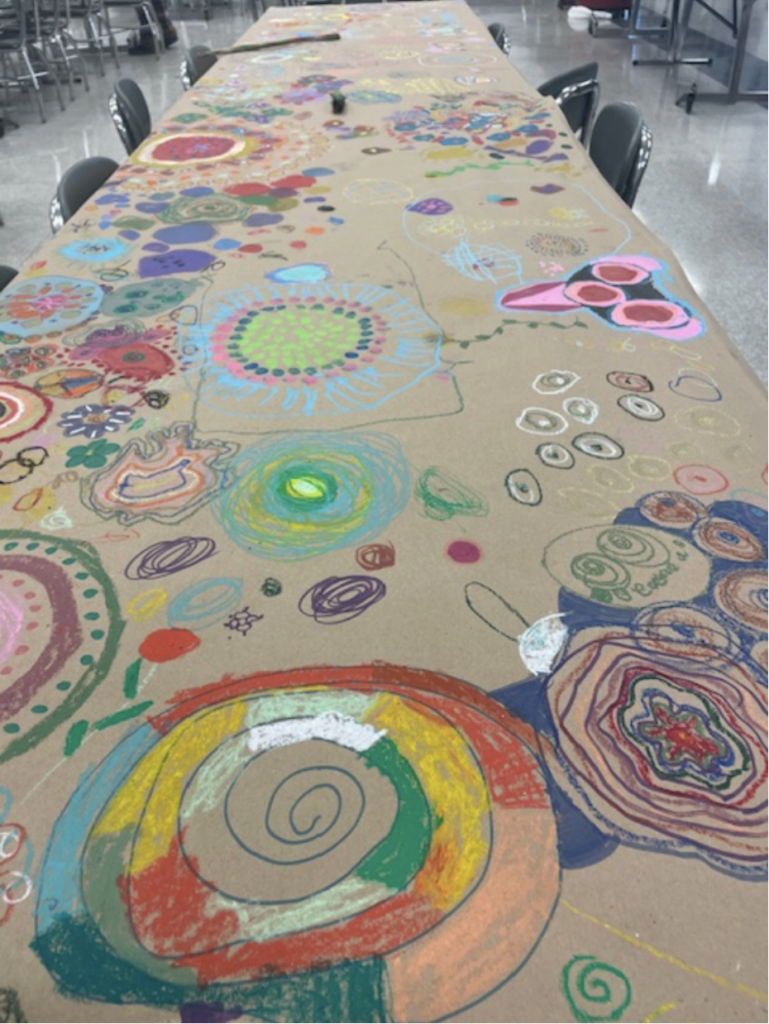
In the wake of Hurricane Helene, Caitlin Adams, a school-based behavioral health specialist, started seeing parallels in how the pandemic and Hurricane Helene were impacting her middle school clients. Neighboring schools had closed for the foreseeable future, and students faced isolation and boredom. But despite the student’s challenges, the families Caitlin normally served would not accept her support, insisting that more directly impacted families needed it more.
Caitlin began volunteering at a Red Cross Shelter with her collaborator, Andi Gelsthorpe, a licensed clinical social worker, registered expressive arts consultant, educator, and artist. The shelter was set up inside a High School in Ashe County, North Carolina. which was set up inside a High School in Ashe County, North Carolina. It was housing about ten residents who had been displaced from their homes. “We decided to bring expressive arts there for the residents and students of the county to come and create,” Caitlin said.
At the shelter, Caitlin and Andi organized a group art project for Ashe County’s school-aged residents. They laid brown paper sheets on the school’s cafeteria tables and invited impacted youth to express themselves creatively.
“Providing the opportunity to create open-ended, process-based art in post-disaster community spaces allows individuals the chance to co-regulate with others, express their emotions in a safe space, and access their internal resources of creativity. Additionally, engaging in the creative process can counteract the body’s fight-or-flight response and support a shift back to a baseline state of normalcy,” Andi said.
“We wanted to remind young people at the shelter, who had experienced long school closures during the pandemic, that they would not have to live through another crisis in isolation.” Said Caitlin.
As a behavioral health specialist, Caitlin knows the power of art has to help people recover from natural disasters.
“During times of crisis, a sense of social connection can protect survivors from experiencing an event as a trauma.” Caitlin said, “Creating art in community provided a critical social resource. This space allowed participants to drop into art making and feel the power of the collective community.”